Short answer: Dual-ISP failover keeps your connection alive when one internet provider fails, and an automatic transfer switch (ATS) moves the building onto a generator within seconds of a power cut. Together they let remote teams keep working through outages. Paxico runs both at Ignite (I-9) and Frontier (F-11 Markaz).
In Islamabad there are two common ways a working day is lost: the power goes, or the internet does. A remote team has little slack for either, because one dropped call can cost a client and one lost deployment can cost a day. This guide explains in plain terms how dual-ISP failover and automatic backup power work, and what to ask any workspace that promises "uninterrupted" service.
Problem one: a single internet provider
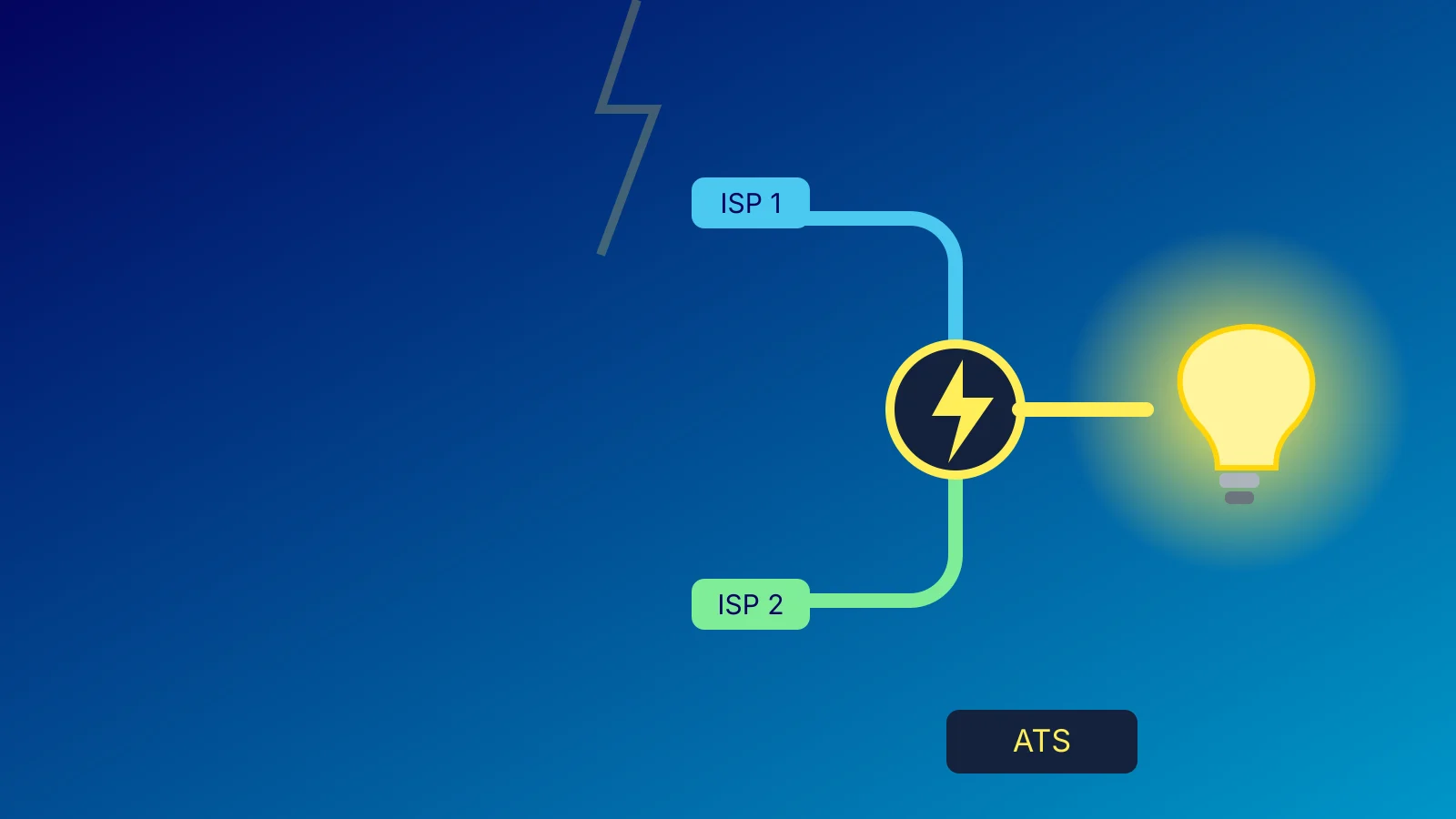
If a workspace depends on one provider, any fault on that line, from a cable cut to a maintenance window, stops everyone. A dual-ISP setup connects the building to two separate internet providers. A router that watches both lines sends traffic through the healthy one, and if the main line fails, it switches to the second automatically. Staff do not need to do anything, and most calls recover within moments.
The two providers should be independent. Two connections from the same provider on the same cable share the same weakness.
Problem two: power cuts
Backup power usually has two layers:
- UPS (uninterruptible power supply). Batteries that carry critical equipment, such as routers, switches and servers, for the few seconds between mains failure and the generator starting. This stops a power cut from rebooting your network.
- Generator with an ATS panel. A generator that can carry the whole workspace, connected through an automatic transfer switch (ATS). When mains power drops, the ATS starts the generator and moves the load across after a few seconds, with no one needing to run to a switch. The generator then keeps running for as long as the outage lasts, and the ATS returns to mains power when it is restored.
Capacity matters as much as the equipment. A small generator that can run only a few lights is not backup power for a team that needs air-conditioning, computers and meeting rooms.
What this means for a remote team
- Calls continue. A switch to the second provider or to the generator does not end a client meeting.
- Work is not lost. Servers, routers and laptops stay powered through the changeover.
- Deadlines are safer. You can schedule releases and demos without watching the load-shedding schedule.
- Costs are shared. Running two internet providers and a large generator is expensive for one small office, but at a workspace the cost is shared across all members.
What operators say publicly
Very few workspaces describe their redundancy in detail. Kickstart's I-10/3 page lists internet with failover connections and power backup, and its 9th Avenue pre-launch page describes two independent fibre connections and uninterrupted power. Cowork24's pages list power backup with their packages. Daftarkhwan's North and Vanguard pages mention a power backup surcharge, but do not describe the system or the internet. A feature missing from a page is not proof it is missing from the building. It means you should ask, and expect a specific answer, such as the number of providers and how a power cut is handled, not a general reassurance.
How Paxico is set up
Both Ignite in I-9 and Frontier in F-11 Markaz run on dual-ISP internet with automatic failover and a high-capacity generator on an ATS panel, backed by UPS for network equipment. After a mains failure the generator takes over within a few seconds and runs for as long as needed. The cost is part of the seat price, so you do not pay separately for fuel or maintenance.
Questions to ask any workspace
- How many internet providers are there, and are they truly independent?
- Does failover happen automatically, or does someone have to switch it?
- Does the generator power the whole workspace or only some areas?
- How long does changeover take, and how long can the generator run?
- Is the network equipment on a UPS?
Better still, test it. Spend a free day with us and judge the connection yourself.
No system can promise zero downtime. Very rare events such as a regional outage affecting both providers can still occur.
The best outage is the one your team never notices. That is how we run both branches, so members can plan a release or a client call without checking the load-shedding schedule first. Come and watch a changeover for yourself.
Frequently asked questions
What is dual-ISP failover?
Two independent internet providers feed one router, which moves traffic to the healthy line automatically if one fails.
How does automatic generator changeover work?
An ATS panel detects the mains failure, starts the generator and moves the load across after a few seconds. The generator runs for as long as the outage lasts.
Does Paxico have this at both branches?
Yes, at Ignite (I-9) and Frontier (F-11 Markaz), and the cost is part of the seat price.
Can any system promise zero downtime?
No. Rare events affecting both providers can still occur, which is why you should ask any workspace specific questions.